


In this article we will be exploring what can be learned from the classic book the "E-Myth" to give perspective and nuances in preparing your business for sale.
The best-selling book The E-Myth: Why Most Small Businesses Don't Work and What to Do About It, written by Michael E. Gerber, was first published in 1985 and revisited in 1995.
The 'E' stands for Entrepreneur and the book identified a myth that all businesses were started by 'entrepreneurs' who risk capital to make a profit.
Michael Gerber pointed out that most businesses are, in fact, started by 'technicians'—people who are good at their jobs, who get rid of their bosses and go into business for themselves. People such as accountants, lawyers, hairdressers, marketers, software developers, chefs, engineers, builders, and many others.
He pointed out that there was a strong correlation between the high failure rate or closure rate of small businesses and those who started them. This was because most 'technicians' weren’t skilled in running or scaling a business.
The book identified three types of personalities required for a business to continually change and thrive:
- The 'entrepreneur' who is always focused on opportunity and the future.
- The 'manager' who organises, plans, and focuses on performance.
- The 'technician' who loves to do the work.
In order for a business owner to be successful, the key is balancing these roles with the business owner’s personality.
People will tend to default to their preferred personality type, so to succeed, the owner must make personal changes to function effectively in each of the roles and must create systems that instil reliability and certainty.
Even though the book was published nearly 40 years ago, statistics today remain very much the same, not just in the US, but across all developed economies of the world. The environment is now more complex, and the pace and scope of change has increased.
Public policy and administration are heavily focused on supporting people getting into business, despite an understanding of the outcomes. In contrast, the level of support for assisting businesses to develop successfully and transition from one generation to another is very limited.
Public policy encourages business startups, but there's a gap when it comes to support for long-term success and smooth generational transitions.
Why Preparing Your Business for Sale is Crucial
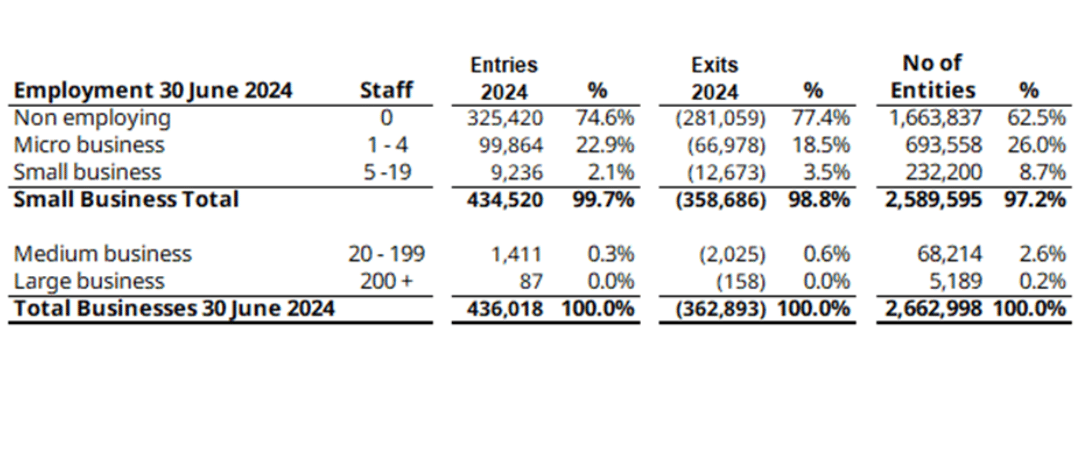
The Australian Bureau of Statistics (1) issues a report every quarter and annually called the 'Counts of Australian Businesses', which reports on the numbers and characteristics of businesses entering and leaving the economy.
The picture for the financial year ended 30 June 2024 is as follows:

The following breakdown by entities highlights the economic churn, wealth destruction, and loss of jobs that occurs, especially in small businesses. While this data is just for one year, we should acknowledge this happens every year, just with slightly different numbers. How does this outcome make sense?
Beyond these statistics, as a society, we need to know:
- What are the characteristics of businesses that have intergenerational longevity?
- How many businesses do and don’t go to market?
Understanding the Challenges of Business Exits
The business broking sector provides anecdotal reporting that 67% of all businesses that are put up for sale do not sell. This data is not segmented by the age of the business or type of entity and how many employees they had.
Assuming the data is an average across all businesses, it implies only 33% of businesses that are put up for sale actually sell. At the highest level, this is a poor result, regardless of perspective. To obtain a deeper qualitative understanding, we need to dig deeper.
- How many of those sales were a success for the owner(s)?
- How many sales involved the enterprise, and how many sales just involved selected assets?
Preparing Your Business for Sale: Key Considerations
Who Buys SMEs?
We need to understand how vibrant the market is for buying a business.
At any point, there are approximately 250,000 businesses available for sale on online listing boards such as 'Seek Commercial' and 'ForSalebyOwner'.
Many businesses for sale are by ‘technicians’—hoping or expecting another ‘technician’ to buy their business rather than starting their own. Reporting from the US says only 1 in 15 individual buyers (6.7%) end up buying a business.
Start with the End in Mind
Ideally, a business should be started with a clear viewpoint on what success is and how the journey may conclude—because one day, it most definitely will. It is better to think ahead and be determined to balance the roles of entrepreneur, manager, and technician in the business.
In other words, set out to be the investor in your business and not just the operator.
This transition can be made while you have time on your side. Attempting this change at the last minute, when you want to exit your business, will likely lead to frustration and disappointment.
"Most entrepreneurs fail because you are working IN your business rather than ON your business."— Michael E. Gerber, E-Myth Revisited
Conclusion: The Importance of a Strategic Exit Plan
It is our mission to shine a light on the road ahead for SME business owners. Most SME business owners have a large portion of their wealth tied up in their business, so maximising its value and appeal is important to setting owners up for the next chapter in their lives.
Take the Next Step
Are you ready to start preparing your business for a successful sale?
Don’t wait until it’s too late. Reach out to Business Exit Partners today for a free consultation and discover how our method of exit preparation can help you maximise your business value and ensure a smooth transition.
1. Australian Bureau of Statistics (Jul2020-Jun2024), Counts of Australian Businesses, including Entries and Exits, ABS Website, accessed 28 August 2024.